
Yuval Avidani
Author
Key Takeaway
WiFi DensePose is a production-ready system that uses standard WiFi router signals to perform real-time 3D human pose estimation through walls without cameras. Created by ruvnet, it solves critical privacy and sensing challenges in healthcare monitoring and disaster recovery by analyzing radio frequency signals instead of optical data.
What is WiFi DensePose?
WiFi DensePose is a computer vision system that replaces optical cameras with commodity WiFi routers for human pose estimation. The project wifi-densepose analyzes Channel State Information from WiFi signals to reconstruct full-body 3D poses in real-time, even through obstacles like walls and rubble. This approach solves the fundamental tension we all face between powerful computer vision capabilities and privacy preservation.
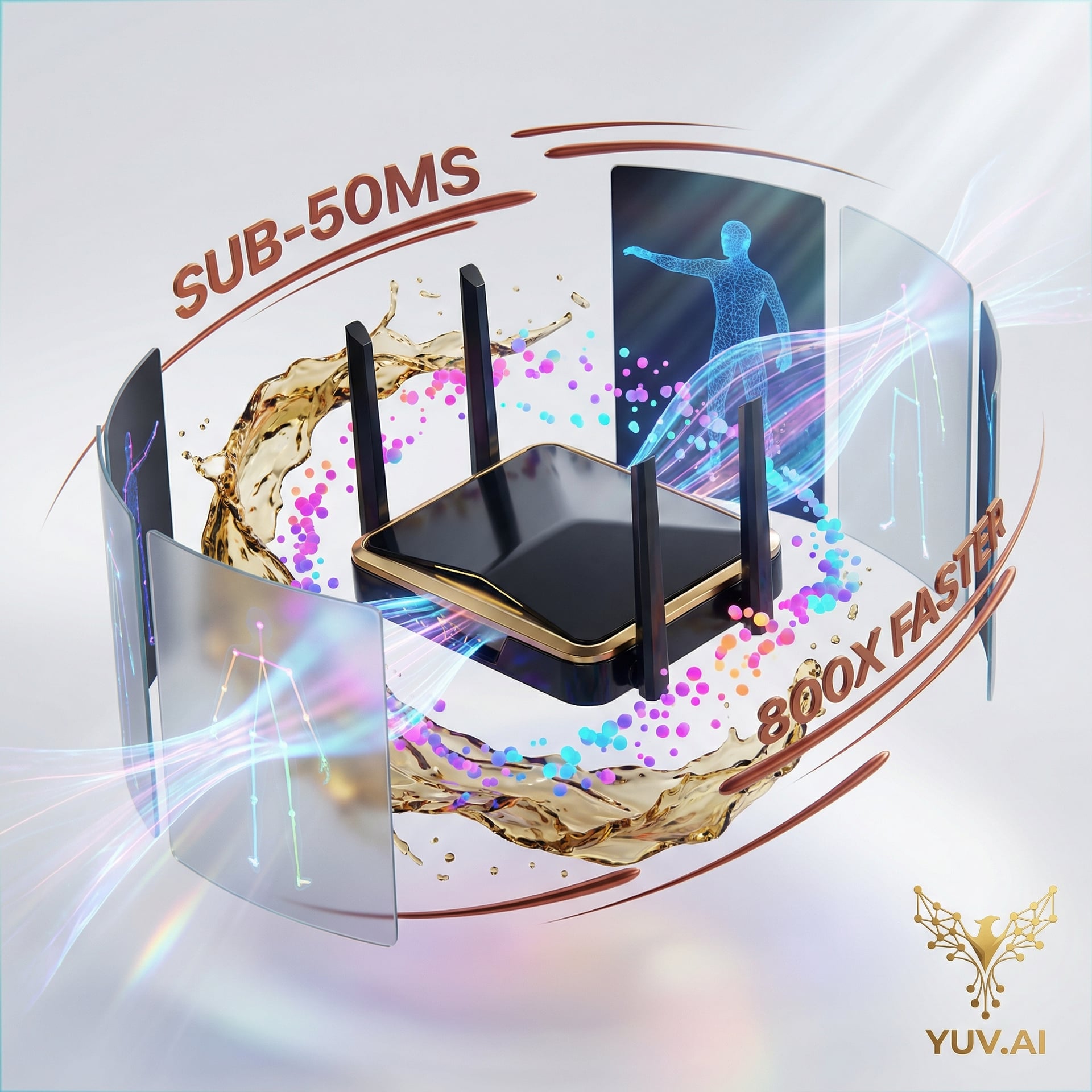
The system represents a breakthrough in RF-based sensing by achieving production-ready performance through a Rust-based architecture that delivers sub-50ms latency with an ~800x speedup over the original Python implementation.
The Problem We All Know
We all face a critical dilemma in computer vision applications: cameras are incredibly powerful for understanding human behavior and detecting emergencies, but they're also inherently invasive. In healthcare facilities, we need to detect falls and monitor patient safety without recording private moments. In disaster scenarios, we need to locate victims trapped under debris where optical sensors simply cannot penetrate.
Traditional camera-based systems capture everything indiscriminately. Even when we implement privacy measures like blur filters or skeleton extraction, the raw optical data exists at some point in the pipeline. This creates liability, erodes trust, and in many cases violates regulations like HIPAA in healthcare contexts.
Radio frequency sensing seemed promising, but existing WiFi-based pose estimation systems suffered from two major limitations: they operated too slowly for real-time applications, and they struggled with accuracy in complex environments. Research prototypes might achieve interesting results in controlled lab settings, but deploying them in real-world scenarios with multiple people, furniture, and environmental interference proved nearly impossible.
How WiFi DensePose Works
WiFi DensePose takes a fundamentally different approach to human sensing by analyzing how radio waves interact with the human body. Instead of capturing reflected light like cameras do, it analyzes Channel State Information - the detailed characteristics of how WiFi signals propagate through space.
Think of it like echolocation: bats emit sound waves and analyze the echoes to build a mental map of their surroundings. WiFi DensePose does something similar with radio waves. When WiFi signals encounter the human body, they're reflected, absorbed, and scattered in patterns that contain rich information about body position and movement. By analyzing these patterns across multiple antennas and frequencies, the system can reconstruct detailed 3D pose information.
The technical innovation lies in how it processes this information. Channel State Information contains amplitude and phase data for each subcarrier in the WiFi signal - essentially giving us a high-dimensional view of how the radio environment changes. Deep learning models trained on paired WiFi-pose datasets learn to map these RF signatures to specific body configurations.
The Rust Architecture Advantage
The evolution to Rust in version 2 transformed this from a research prototype into a production system. The original Python implementation was functional but too slow for real-time applications. The Rust rewrite achieved:
- ~800x speedup in the full pipeline - bringing latency down to sub-50ms for real-time operation
- ~5400x improvement in motion detection - enabling instant response to human movement
- Memory safety without garbage collection overhead - critical for embedded deployment scenarios
- Zero-cost abstractions - meaning we get high-level expressiveness without runtime performance penalties
Quick Start
Here's how we get started with WiFi DensePose:
# Clone the repository
git clone https://github.com/ruvnet/wifi-densepose.git
cd wifi-densepose

# Install dependencies (requires Rust toolchain)
cargo build --release

# Configure your WiFi adapters
./configure_adapters.sh

# Run the pose estimation system
cargo run --release -- --config config.yaml
A Real Example
Let's say we want to set up fall detection in an elder care facility. Here's how we configure the system:
# config.yaml for healthcare monitoring
device:
  router_ips: ["192.168.1.1", "192.168.1.2", "192.168.1.3"]
  sample_rate: 1000  # 1000 Hz CSI sampling

model:
  checkpoint: "models/healthcare_v2.pth"
  confidence_threshold: 0.85

detection:
  fall_detection: true
  alert_endpoint: "https://nursing-station.local/alert"
  privacy_mode: true  # No raw data storage

processing:
  latency_target_ms: 50
  motion_sensitivity: "high"
The system continuously analyzes CSI data from multiple routers positioned around the monitored area. When it detects a pose configuration consistent with a fall - sudden vertical displacement, horizontal body orientation, rapid deceleration - it triggers an alert to the nursing station. Critically, no visual data ever exists, preserving patient dignity.
Key Features
- Through-wall sensing - Works through obstacles that block optical sensors completely. Think of it like having X-ray vision, but instead of harmful radiation, we're using existing WiFi signals that are already present in the environment.
- Complete privacy preservation - No cameras, no recordings, no identifiable visual data. The system only knows body pose geometry, not identity, appearance, or any personally identifiable information.
- WiFi-Mat disaster recovery module - Specialized mode for detecting humans under rubble in earthquake or building collapse scenarios. While optical and thermal sensors fail when victims are buried, RF signals can penetrate debris to locate survivors.
- Production-ready performance - The Rust architecture delivers real-time operation with sub-50ms latency, making it viable for safety-critical applications where delayed detection could mean the difference between life and death.
- Standard hardware compatibility - Works with commodity WiFi routers rather than requiring specialized RF equipment, dramatically reducing deployment cost and complexity.
When to Use WiFi DensePose vs. Alternatives
WiFi DensePose excels in scenarios where privacy and obstacle penetration matter more than visual fidelity. If we need to identify individuals, read text, or analyze fine-grained visual details, traditional cameras remain the better choice. But for pose estimation specifically, particularly in privacy-sensitive or optically-obstructed environments, RF sensing offers unique advantages.
Compared to other RF sensing approaches like mmWave radar or UWB, WiFi has the advantage of leveraging existing infrastructure. Most facilities already have WiFi coverage, so we can add pose sensing without deploying new hardware. The trade-off is slightly lower spatial resolution compared to higher-frequency systems, but for many applications - fall detection, occupancy monitoring, disaster recovery - the resolution is more than sufficient.
Systems like OpenPose or MediaPipe offer better pose accuracy when optical conditions are good, and they can handle more complex scenarios like hand pose estimation or facial landmarks. But they fundamentally cannot see through walls, and they raise privacy concerns that WiFi DensePose sidesteps entirely.
My Take - Will I Use This?
In my view, this represents one of the most practical applications of RF sensing I've seen. The combination of privacy preservation and obstacle penetration opens up use cases that simply weren't viable with optical sensing. The fact that it achieves production-ready performance through the Rust architecture takes it from "interesting research" to "deployable technology."
I can see immediate applications in elder care facilities where we need fall detection without cameras invading privacy. The WiFi-Mat disaster recovery capability is particularly compelling - in earthquake-prone regions or conflict zones, having a rapid-deployment system that can locate survivors under rubble could save lives.
The limitations are real though. This works best in controlled environments where we can position routers strategically and calibrate the system. In highly dynamic spaces with constantly changing layouts or large crowds, the accuracy degrades. It's also not going to replace cameras for applications that need visual details beyond pose - if we need to read a license plate or identify someone's face, optical sensing is still necessary.
But for the specific problem domain it targets - privacy-preserving pose estimation in optically-challenging environments - this is genuinely innovative work. The open-source nature means we can adapt it for specialized use cases, and the Rust codebase makes it feasible to deploy on edge devices or embedded systems.
Check out the full project at wifi-densepose to explore the implementation and see the disaster recovery modules in action.
Frequently Asked Questions
What is WiFi DensePose?
WiFi DensePose is a computer vision system that uses commodity WiFi router signals to perform real-time 3D human pose estimation through walls, providing complete privacy preservation by eliminating the need for optical cameras.
Who created WiFi DensePose?
WiFi DensePose was created by ruvnet, building on the InvisPose research foundation and evolving it into a production-ready system with a high-performance Rust core.
When should we use WiFi DensePose?
Use WiFi DensePose when privacy is paramount and optical sensors are impractical - healthcare monitoring, elder care fall detection, or disaster recovery scenarios where victims are hidden under debris.
What are the alternatives to WiFi DensePose?
Alternatives include camera-based systems like OpenPose or MediaPipe for higher accuracy when privacy isn't a concern, mmWave radar systems for higher-resolution RF sensing, or UWB systems for precise indoor positioning - each with different trade-offs in privacy, cost, and infrastructure requirements.
What are the limitations of WiFi DensePose?
The main limitations are that it requires strategic router placement and calibration, works best in controlled environments rather than highly dynamic spaces, and cannot provide visual details beyond pose geometry - if you need to identify individuals or analyze fine visual features, optical cameras remain necessary.