
Yuval Avidani
Author
Key Takeaway
Qwen-Agent is an advanced framework for building LLM applications with native tool execution, planning, and memory capabilities. Created by QwenLM, it solves the critical problem of reliable tool integration in AI agents by providing built-in function calling, Model Context Protocol (MCP) support, Docker-sandboxed code execution, and RAG - all optimized for Qwen 3.5 and QwQ-32B models.
What is Qwen-Agent?
Qwen-Agent is a production-grade framework for developing LLM applications based on the instruction following, tool usage, planning, and memory capabilities of Qwen models. The project Qwen-Agent solves the problem of building reliable AI agents that we all face when trying to integrate multiple tools, handle code execution safely, and maintain context across conversations.
Unlike generic agent frameworks that require extensive prompt engineering to get tools working, Qwen-Agent natively understands how Qwen models parse and execute function calls. This means we spend less time debugging tool integration and more time building actual features.
The Problem We All Know
We've all been there: we build an AI agent, wire up some tools, and it works beautifully in our demos. Then we hit production and everything falls apart. Function calls fail on edge cases. Our code interpreter executes untrusted code and opens security holes. RAG context gets lost between conversations. Tools don't play nicely together, creating race conditions and dependency nightmares.
We patch these issues with custom wrappers, middleware layers, and endless prompt tweaking. Our codebase becomes a maze of glue code just to make basic tool calling reliable. Other frameworks like LangChain and LlamaIndex help, but we still write tons of integration logic. We're forced to choose between high-level abstractions that hide too much or low-level primitives that make us rebuild everything.
How Qwen-Agent Works
Think of Qwen-Agent like a professional kitchen - instead of just giving us ingredients (LLMs and APIs), it provides us with organized workstations, standardized tools, and safety protocols. The framework is built on three layers:
Atomic Components - These are our basic building blocks: LLMs (Qwen models or custom endpoints) and Tools (functions our agents can call). Every tool has a standardized interface, meaning - a consistent way to describe what it does, what inputs it needs, and what outputs it returns.
High-Level Components - These are pre-built agents that combine atomic components intelligently. The Assistant agent handles multi-turn conversations with tool usage. The CodeInterpreter agent can write and execute Python code safely. The RAG agent manages document retrieval and context.
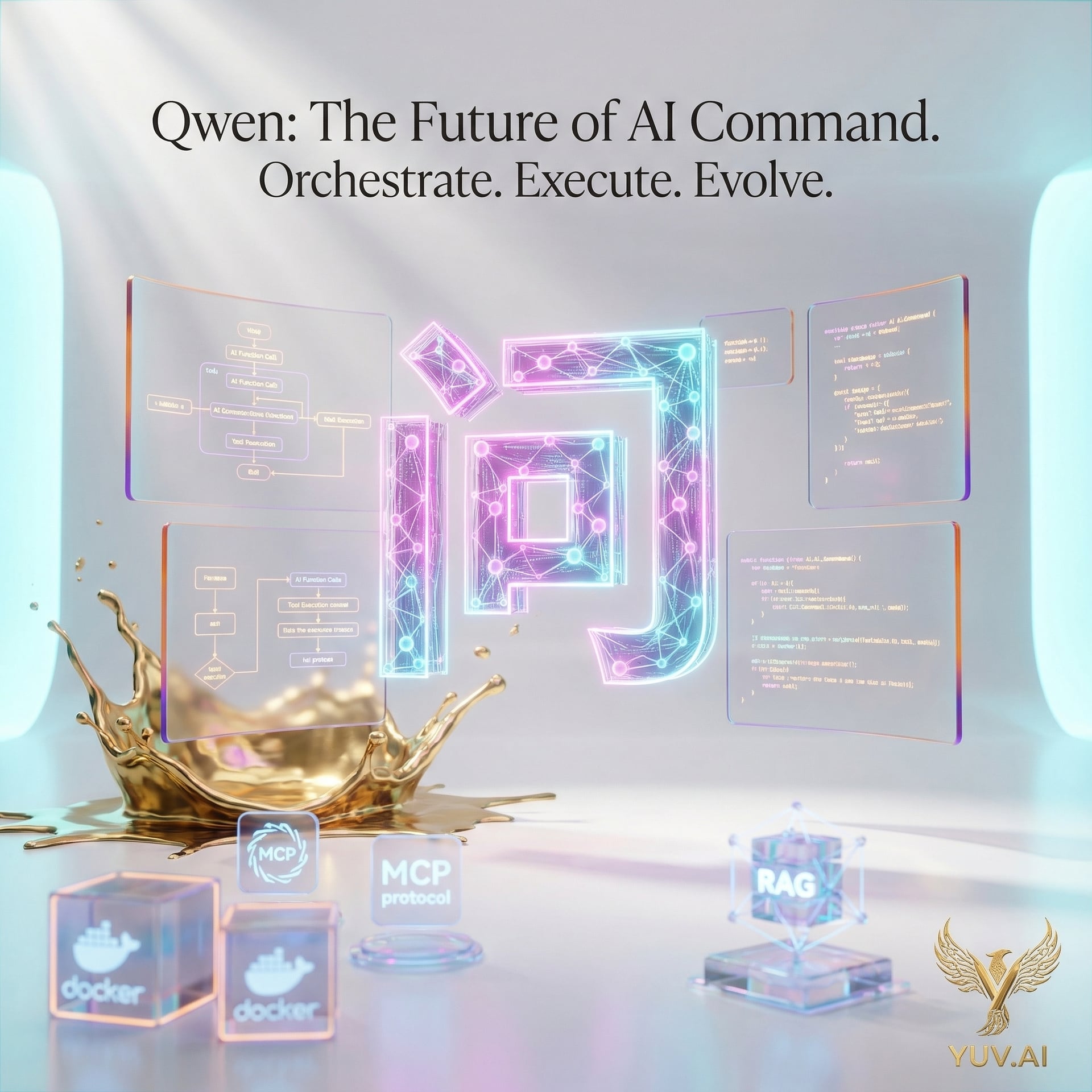
Orchestration Layer - This is where the magic happens. Qwen-Agent handles parallel function calls automatically, meaning - if our agent decides to call three tools simultaneously, the framework executes them in parallel and merges results without race conditions. It integrates MCP (Model Context Protocol) - a standardized way for agents to discover and use external resources like databases, file systems, and APIs. All code execution happens in isolated Docker containers, so malicious or buggy generated code can't harm our production environment.
Quick Start
Here's how we get started with Qwen-Agent:
# Installation
pip install qwen-agent

# Basic agent with built-in tools
from qwen_agent.agents import Assistant

agent = Assistant(
    llm={'model': 'qwen-plus'},  # or 'qwen-turbo', 'qwen-max'
    function_list=['code_interpreter', 'image_gen']
)

# Agent handles tool execution automatically
response = agent.run('Analyze sales data and create visualization')
print(response)
A Real Example
Let's say we want to build a data analysis agent that can write code, execute it safely, and remember previous analyses:
from qwen_agent.agents import Assistant
from qwen_agent.tools import CodeInterpreter
from qwen_agent.memory import Memory

# Configure agent with memory and code execution
agent = Assistant(
    llm={
        'model': 'qwen-plus',
        'api_key': 'your-api-key',
        'model_server': 'dashscope'  # or vLLM, Ollama
    },
    function_list=['code_interpreter'],
    system_message='You are a data analyst. Write Python code to analyze data.'
)

# Memory persists across conversations
memory = Memory()

# First analysis
query1 = 'Load sales.csv and calculate monthly revenue'
response1 = agent.run(query1, memory=memory)
print(response1)

# Follow-up uses previous context
query2 = 'Now compare this quarter to last quarter'
response2 = agent.run(query2, memory=memory)  # Remembers sales.csv
print(response2)
The code interpreter runs in a Docker sandbox, so even if our agent generates code that tries to delete files or make network calls, it can't affect our production system. The memory module stores conversation history and tool outputs in a structured format, enabling our agent to reference previous work naturally.
Key Features
- Native Function Calling - Qwen models understand tool schemas without prompt engineering. Think of it like hiring someone who already speaks the same language as our tools - no translation needed. The framework parses function calls directly from model outputs, handles parameter validation, and manages execution automatically.
- Model Context Protocol (MCP) Integration - MCP is a standardized way for agents to discover and use resources. Imagine walking into a new office and immediately knowing where every tool, document, and system is - that's what MCP does for our agents. We can connect to databases, file systems, APIs, and custom services without writing integration code for each one.
- Docker-Sandboxed Code Execution - Generated code runs in isolated containers with resource limits and network restrictions. Think of it like a testing lab with reinforced walls - our agent can experiment freely without risking the main facility. The framework manages container lifecycle, captures outputs, and handles errors gracefully.
- Built-in RAG (Retrieval-Augmented Generation) - The framework includes document chunking, embedding, vector storage, and retrieval out of the box. Instead of building our own RAG pipeline, we get a production-ready system that handles document ingestion, similarity search, and context injection automatically.
- Parallel Tool Execution - When our agent needs to call multiple tools, the framework executes them concurrently and merges results intelligently. Think of it like a chef coordinating multiple dishes - everything finishes at the right time and comes together coherently.
- Multi-Model Support - While optimized for Qwen models, the framework works with any LLM via vLLM, Ollama, or API endpoints. We can swap models without rewriting our agent logic.
When to Use Qwen-Agent vs. Alternatives
Qwen-Agent shines when we need production-grade tool reliability with Qwen models. If we're already using Qwen 3.5 or QwQ-32B, this framework gives us native integration without prompt engineering. The MCP support means our agents can scale to complex environments - connecting to databases, file systems, APIs, and custom services without custom connectors for each one.
LangChain offers broader ecosystem support and works well when we need to integrate many different LLM providers and tools. Choose LangChain when ecosystem compatibility matters more than native optimization. LlamaIndex excels at RAG-focused applications with sophisticated document processing. Choose LlamaIndex when our primary use case is document QA and we need advanced retrieval strategies.
AutoGPT and similar autonomous frameworks work better for open-ended tasks where we want minimal human intervention. Choose those when we're building autonomous systems rather than assistant-style agents. Qwen-Agent fits the middle ground - more structured than fully autonomous agents, more production-ready than experimental frameworks.
My Take - Will I Use This?
In my view, Qwen-Agent represents the maturation of AI agent frameworks. The native Qwen integration eliminates the biggest pain point we face with generic frameworks - unreliable tool calling. When I wire up a tool in LangChain, I spend hours tweaking prompts to get function calls working consistently. With Qwen-Agent, tools just work because the framework and models are designed together.
The MCP integration is the real game-changer for our workflow. Instead of writing custom connectors for every database, API, and service our agents need to access, we implement MCP once and get standardized access to everything. This dramatically reduces the integration code we maintain.
Will I use this? Absolutely, especially for production projects where tool reliability matters more than framework flexibility. The Docker-sandboxed code execution gives us confidence to deploy agents that generate and run code. The built-in RAG saves us from maintaining yet another retrieval pipeline. The parallel tool execution handles the complexity of orchestrating multiple tool calls without race conditions.
The limitation is clear: this is optimized for Qwen models. If we're committed to OpenAI or Anthropic models, we'll fight the framework rather than benefit from it. But if we're building on Qwen - especially the newly open-sourced Qwen 3.5 and QwQ-32B - this is the production infrastructure we've been waiting for.
Check out the project: Qwen-Agent on GitHub
Frequently Asked Questions
What is Qwen-Agent?
Qwen-Agent is an advanced framework for building LLM applications with native tool execution, planning, and memory capabilities, optimized for Qwen models.
Who created Qwen-Agent?
Qwen-Agent was created by QwenLM, the team behind the Qwen series of large language models.
When should we use Qwen-Agent?
Use Qwen-Agent when building production AI agents with Qwen models that need reliable tool execution, code interpretation, MCP integration, and persistent memory across conversations.
What are the alternatives to Qwen-Agent?
Alternatives include LangChain (broader ecosystem, multi-provider support), LlamaIndex (RAG-focused with advanced retrieval), and AutoGPT (autonomous agent frameworks). Qwen-Agent offers tighter Qwen integration and production-ready tool execution compared to generic frameworks.
What are the limitations of Qwen-Agent?
Qwen-Agent is optimized for Qwen models - other LLMs work but may require custom configuration for function calling. The framework assumes Docker availability for sandboxed code execution, which may not suit all deployment environments.