
Yuval Avidani
Author
Meta AI finally speaks Hebrew, straight from inside WhatsApp, the app we're all already glued to all day long. That's the real news for Israelis this month, and it comes with one big asterisk we shouldn't miss.
Meta AI has launched in Israel with Hebrew support for the first time, built directly into WhatsApp and into meta.ai on desktop and mobile. According to reports in Israeli and international press from late June, this isn't a pilot anymore and it's not an English-only beta. We can now open a chat in Hebrew with Meta's assistant exactly the way we'd text a friend, and ask it to generate text, create and edit images and video from text, and even upload a photo and get real-time analysis of it.
Let's break this down, because there are two stories here that are really easy to mix up: there's the software landing on our phones right now, and there's Meta's famous glasses. And those are two completely different things.
What actually happened: Meta AI in Hebrew, without leaving the chat
The exciting part here isn't "one more AI assistant on the pile." It's where it lives. Think of it like the difference between installing a new app versus discovering it's already installed inside an app you open fifty times a day anyway. Meta AI drops straight into WhatsApp, the place we're all already hanging out, with no download and no separate signup.
In terms of what it actually does for us, the reports highlight three main uses: content creation (text, and images and video generated from text), analysis of photos we upload, and reasoning through more complex, multi-step questions. So it's not just "write me a nice message" — it's also "here's a photo, what am I looking at," and tasks that require several logical steps.
Muse Spark: the engine under the hood
Behind all of this sits a model called Muse Spark. Quick explainer: an AI model is basically the computational brain that generates the answers, and every smart assistant runs on top of one of these underneath. Muse Spark is a multimodal model from Meta Superintelligence Labs, unveiled on April 8, 2026, and Meta describes it as its first multimodal reasoning model.
"Multimodal" is a scary word with a simple meaning: a model that can work with several types of media at once, not just text but images too. Think of the difference between an employee who can only read documents, versus one who can also look at a picture and understand what's happening in it. Muse Spark, according to Meta, is built from the ground up this way, with tool-use capabilities, "visual chain-of-thought" (meaning it can reason step-by-step about images too), and orchestration of several agents working together.
And here's the part worth taking with a grain of salt: Meta claims the model beats Claude 4.6 Opus, Gemini 3.1 Pro and GPT-5.4 on several benchmarks, including HealthBench Hard. A benchmark is a standardized test used to compare models on the same tasks, kind of like a national exam. I think it's important to be fair here: these are numbers coming from the manufacturer itself, and each competitor has its own approach and its own strengths. A company claiming victory over its own product is the start of a discussion, not the final word.
Why now, and why it feels "late"
Ynet makes a point I think is worth pausing on: Meta AI's arrival in Israel is "relatively late compared to the other major players" in the AI market. And that's a bit strange, because Meta is far from a stranger to Israel. It has an R&D presence here, and even a joint PhD program with the Hebrew University of Jerusalem going back to 2022.
So we've got a situation where the company has been developing here for years, but the consumer product, in Hebrew, only lands now, in the middle of 2026. I don't have a clean answer for why, and the reports don't offer one either. But that's exactly why it's worth paying attention: sometimes the gap between "there's an impressive R&D center here" and "the product actually works in my language" is a gap of years.
And the glasses? The big asterisk of this story
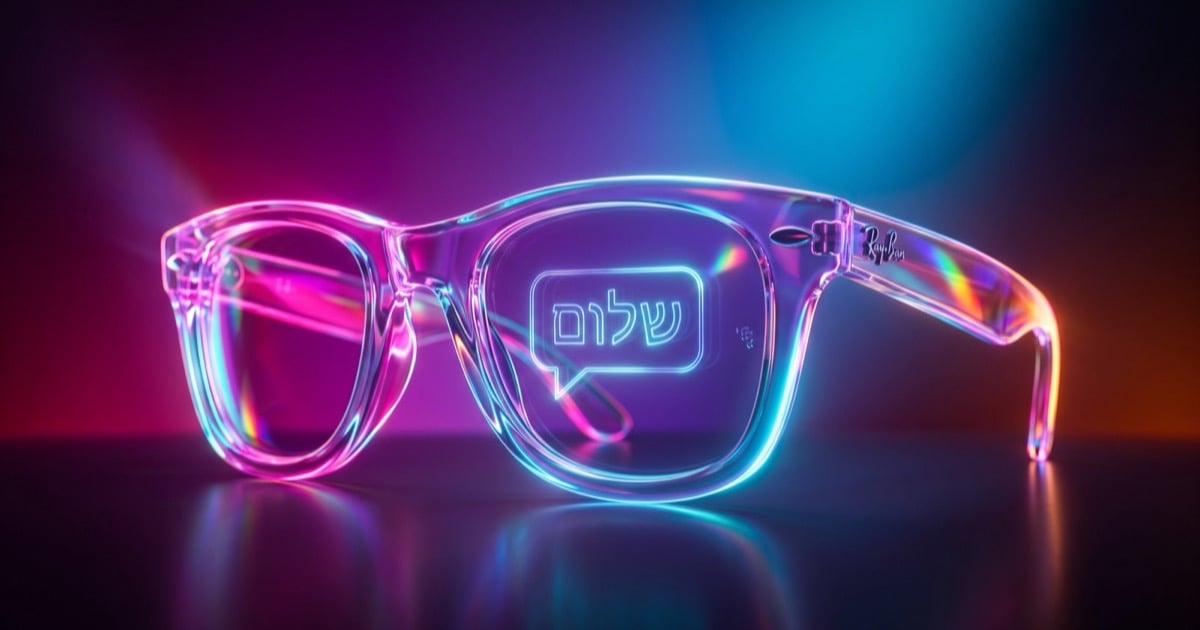
Now for the part I've been writing this whole article carefully around. Alongside the software news, Meta has an especially cool hardware story, and that's exactly what's causing the confusion. Meta's glasses are a real story, but they are not officially coming to Israel yet, and no source confirms otherwise.
Let's look at what actually exists out there in the world. There's the Ray-Ban Meta Gen 2, announced on September 17, 2025, starting at $379. They deliver up to 8 hours of battery life (roughly double the first generation), charge to 50% in 20 minutes, and the charging case adds another 48 hours. They shoot 3K Ultra HD video with wide HDR at up to 60 frames per second, and get live translation expanding to German and Portuguese, so you can hold a back-and-forth conversation in 6 languages, even in airplane mode with pre-downloaded language packs.
And then there's the more futuristic one: Meta Ray-Ban Display, Meta's first glasses with a built-in screen right inside the lens, which launched September 30, 2025 in the US at $799. That price includes a wristband called the Meta Neural Band. Let's unpack both parts, because they're genuinely cool.
The display itself is a monocular (meaning single-eye) full-color display at 600x600 resolution in the right lens, with a field of view of about 20 degrees and brightness ranging from 30 to 5,000 nits (bright enough for Israeli sunshine, by the way). Through it you can get visual answers from Meta AI, see messages from WhatsApp, Messenger and Instagram, run a video call, get step-by-step walking navigation, and see live captions and translation right in front of your eyes.
And the wristband? The Meta Neural Band reads the electrical signals from the muscles in your arm (a technology called surface-EMG). In plain terms: instead of touching the glasses or talking to them, you make a tiny, almost imperceptible finger movement, and the band translates it into a command. Think of it like an invisible mouse sitting on your wrist. It weighs 42 grams, lasts up to 18 hours, and is IPX7 water resistant.
Bottom line: what's actually relevant to us right now
Here's the distinction I want you to walk away with. What's landing in Israel right now is the software: Meta AI in Hebrew inside WhatsApp. Not the glasses. The international rollout of Meta Ray-Ban Display was originally announced for early 2026 in Canada, France, Italy and the UK, but Meta froze it on January 6, 2026 due to unprecedented demand and limited stock (waitlists stretch deep into 2026), and as of now no new date has been set. Israel wasn't on that list in any source I found anyway. So if you see someone writing that the glasses "launched in Israel," go ahead and ask them for a source link.
In my view, the news is still net-positive for most of us. An AF assistant that speaks Hebrew, lives where we already are, and generates images and analyzes photos without a separate app, that's genuinely useful from day one, without buying any $799 hardware. That said, two caveats: one, the benchmark claims are Meta grading its own homework, so let's wait for independent testing; and two, when we're chatting with an AI assistant inside WhatsApp, it's worth remembering we're sharing information with a commercial platform, so don't go uploading sensitive stuff there just because you can.
So now that we've got it straight, the software is here and the glasses aren't yet, what's the first thing you're going to ask Meta AI in Hebrew the moment you open WhatsApp?