
Yuval Avidani
Author
Key Finding
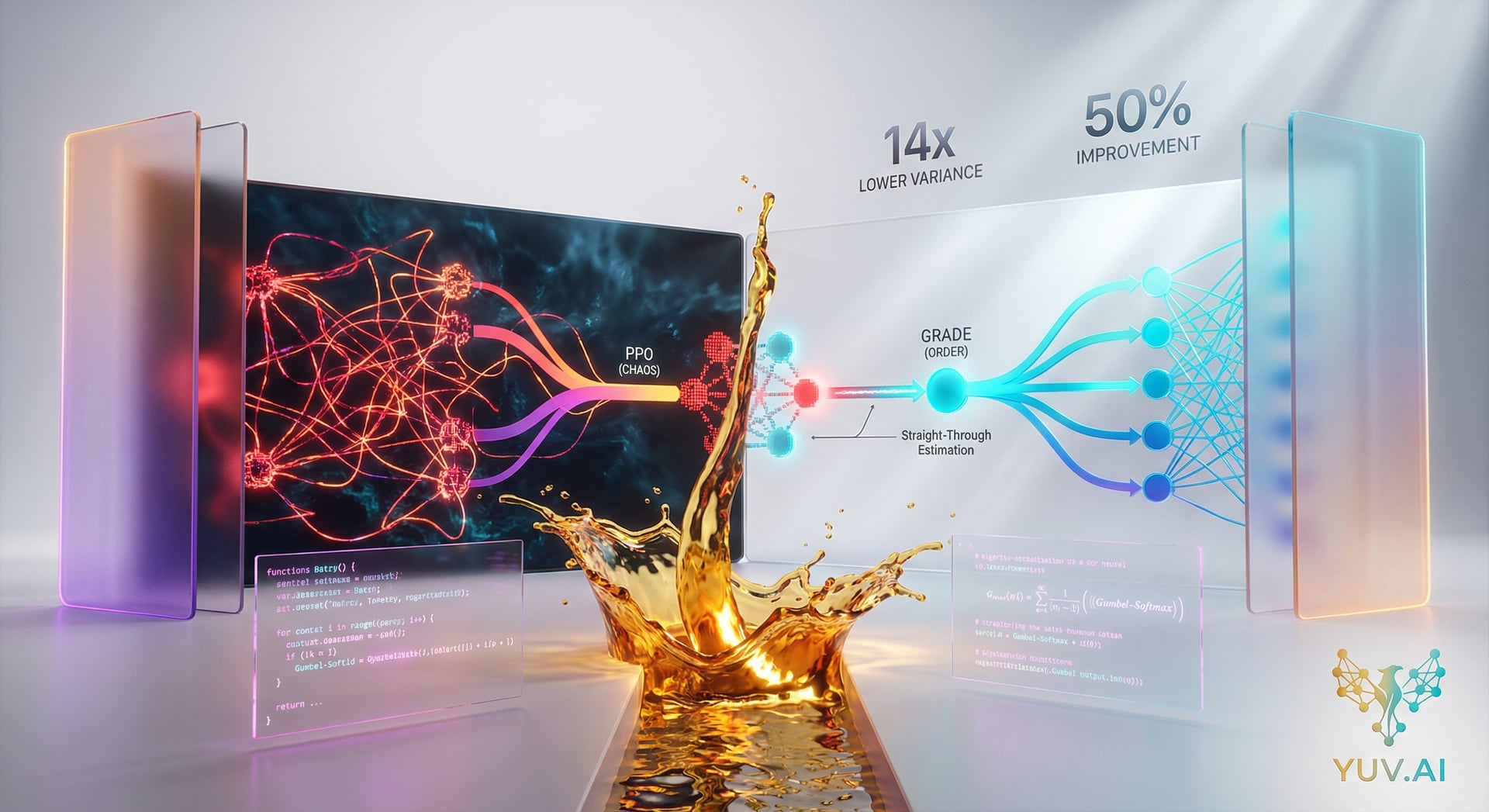
According to the paper "GRADE: Replacing Policy Gradients with Backpropagation for LLM Alignment" by Lukas Abrie Nel, replacing the standard PPO algorithm with a fully differentiable approach reduces gradient variance by 14x and improves alignment performance by 50%. This has significant implications for every team deploying RLHF in production, offering a path to stable, efficient LLM alignment without PPO's notorious hyperparameter sensitivity.
What Does LLM Alignment Mean?
LLM alignment refers to the process of training our language models to follow human preferences and instructions reliably. The paper GRADE: Replacing Policy Gradients with Backpropagation for LLM Alignment tackles the core challenge we all face: how to make our models behave the way we want them to, not just predict the next token accurately.
Currently, Reinforcement Learning from Human Feedback (RLHF) is our primary tool for alignment. We train a reward model on human preferences, then use that model to guide our LLM toward better behavior. The industry standard approach uses Proximal Policy Optimization (PPO) - a reinforcement learning algorithm that treats text generation as a policy that needs optimization.
The Problem We All Face
We all know the pain of PPO-based RLHF. Our models generate discrete tokens - actual words and characters that cannot be partially generated. But here's the fundamental issue: we cannot backpropagate through the sampling operation that selects these discrete tokens. The operation is non-differentiable, meaning gradients cannot flow backward through it.
Because we cannot backpropagate directly, we resort to policy gradient methods like REINFORCE or PPO. These methods estimate gradients by sampling multiple trajectories and computing weighted averages. This estimation process introduces massive variance - our gradient estimates are noisy, requiring enormous batch sizes to get reliable signals. Production teams spend weeks tuning hyperparameters, fighting mode collapse where the model repeats the same outputs, and dealing with reward hacking where the model exploits loopholes in the reward function.
The instability is so severe that many teams maintain separate codebases for RLHF, use grid searches over dozens of hyperparameter combinations, and still see training runs fail unpredictably. PPO is powerful but fragile - exactly the combination we do not want in production systems.
What the Researchers Found
GRADE (Gumbel-softmax Relaxation for Alignment via Differentiable Estimation) proposes abandoning the reinforcement learning formulation entirely. Instead of treating text generation as a policy optimization problem, GRADE makes the entire alignment process fully differentiable - meaning we can use standard backpropagation, just like in supervised learning.
Think of it like this: imagine trying to teach someone to paint by describing the brush strokes afterward (policy gradients) versus guiding their hand in real-time (direct gradients). GRADE enables the real-time guidance approach for LLM alignment.
Here is how GRADE achieves this technically:
Gumbel-Softmax Relaxation: Instead of sampling a discrete token using argmax or multinomial sampling, GRADE uses the Gumbel-Softmax trick. It adds Gumbel noise to the logits (the raw model outputs before converting to probabilities) and applies a temperature-controlled softmax. At high temperatures, this produces smooth probability distributions. At low temperatures, it approximates discrete one-hot selections. Crucially, the entire operation is differentiable - meaning gradients can flow through it.
Straight-Through Estimation (STE): Here is where it gets clever. During the forward pass (when the model generates text), GRADE discretizes the output so the model produces actual tokens. This is essential because subsequent autoregressive steps need real tokens as input. However, during the backward pass (when computing gradients), GRADE bypasses the discrete step and flows gradients through the continuous Gumbel-Softmax values. This means the reward signal from our reward model can propagate directly to the LLM parameters.
What this means in practice: the optimizer sees exactly how changing a weight affects the reward, rather than guessing via noisy policy samples. The reward model becomes almost like a loss function in supervised learning - we can backpropagate through it directly.
Practical Implementation
Here is what this looks like in practice:
# Example: GRADE forward pass with Gumbel-Softmax
import torch
import torch.nn.functional as F

def grade_forward_pass(logits, temperature=0.5):
    """
    GRADE's differentiable token selection using Gumbel-Softmax
    Args:
        logits: raw model outputs [batch, vocab_size]
        temperature: controls discretization (lower = more discrete)
    """
    # Add Gumbel noise for exploration
    gumbel_noise = -torch.log(-torch.log(torch.rand_like(logits)))
    noisy_logits = (logits + gumbel_noise) / temperature

    # Continuous approximation (differentiable)
    soft_tokens = F.softmax(noisy_logits, dim=-1)

    # Discrete tokens for forward pass (actual generation)
    hard_tokens = F.one_hot(soft_tokens.argmax(dim=-1), logits.size(-1))

    # Straight-through: discrete forward, continuous backward
    return hard_tokens.detach() - soft_tokens.detach() + soft_tokens

# The gradient flows through soft_tokens but forward pass uses hard_tokens
# This is the magic that makes alignment differentiable
Another practical example showing the end-to-end training loop:
# Example: GRADE training loop replacing PPO
import torch
from transformers import AutoModelForCausalLM, AutoTokenizer

def train_grade_alignment(model, reward_model, prompts, epochs=10):
    """
    Train LLM alignment using GRADE - fully differentiable!
    No PPO, no policy gradients, just backpropagation
    """
    optimizer = torch.optim.AdamW(model.parameters(), lr=1e-5)

    for epoch in range(epochs):
        for prompt in prompts:
            # Generate with Gumbel-Softmax (differentiable)
            generated_tokens = []
            hidden_state = model.get_input_embeddings()(prompt)

            for step in range(max_length):
                logits = model(inputs_embeds=hidden_state).logits[:, -1, :]

                # GRADE's differentiable token selection
                token_probs = grade_forward_pass(logits, temperature=0.5)
                generated_tokens.append(token_probs)

                # Next input (differentiable embedding)
                next_embedding = token_probs @ model.get_input_embeddings().weight
                hidden_state = torch.cat([hidden_state, next_embedding.unsqueeze(1)], dim=1)

            # Compute reward (also differentiable!)
            generated_text = decode_soft_tokens(generated_tokens)
            reward = reward_model(prompt, generated_text)

            # Direct backpropagation - no policy gradients needed!
            loss = -reward  # Maximize reward = minimize negative reward
            loss.backward()
            optimizer.step()
            optimizer.zero_grad()

    return model
Key Results & Numbers
- Gradient Variance Reduction: GRADE exhibits gradient variance over 14 times lower than REINFORCE - meaning 14x more stable training with smoother loss curves. In practical terms, we need far fewer samples per batch and less hyperparameter tuning.
- Alignment Performance: On sentiment-controlled generation using the IMDB dataset, GRADE achieved a test reward of 0.763 compared to PPO's 0.510 - that is a 50% relative improvement. In other words, GRADE-aligned models are substantially better at following the intended sentiment direction.
- Generalization: GRADE showed superior generalization to held-out data compared to PPO. This suggests it learns robust features about what makes text align with preferences, rather than memorizing specific reward patterns or exploiting artifacts in the reward model.
- Training Stability: Loss curves in the paper show GRADE maintains consistent improvement throughout training, while PPO exhibits the characteristic instability and variance spikes we all know too well.
How This Fits Our Toolkit
GRADE complements existing approaches rather than replacing everything. PPO and policy gradient methods remain valuable for scenarios where we cannot make the reward function differentiable - such as when using human evaluators in the loop or optimizing for complex multi-step reasoning tasks.
However, for cases where we have a differentiable reward model (which covers many practical alignment scenarios), GRADE offers significant advantages. It combines the objective-driven optimization of RLHF with the stability and simplicity of supervised fine-tuning. We get to keep the benefits of optimizing for our actual objective (human preferences) while avoiding the hyperparameter sensitivity and variance issues of PPO.
Think of it as having three tools in our alignment toolkit: supervised fine-tuning for when we have good demonstration data, PPO-based RLHF for when we need policy optimization with non-differentiable rewards, and GRADE for when we want the best of both worlds with differentiable reward models.
My Take - Should We Pay Attention?
In my view, this is a significant development for production teams dealing with LLM alignment. The 14x reduction in gradient variance alone makes this worth exploring - we all know how much time gets wasted debugging PPO instability and tuning hyperparameters.
The key practical advantage is not just better performance, but predictability. GRADE training behaves more like standard supervised learning, which means our existing intuitions about learning rates, batch sizes, and optimization dynamics apply more directly. For teams with limited compute budgets who cannot afford extensive hyperparameter sweeps, this is valuable.
The main limitation is the requirement for a differentiable reward model. Not all alignment objectives fit this constraint - tasks involving multi-turn interactions, complex reasoning chains, or direct human evaluation may still need policy gradient approaches. But for sentiment control, style transfer, safety filtering, and similar tasks where we can train a reward model, GRADE provides a more stable path forward.
Read the full paper: GRADE: Replacing Policy Gradients with Backpropagation for LLM Alignment
Frequently Asked Questions
What does GRADE find?
GRADE achieves 14x lower gradient variance and 50% better alignment performance compared to PPO by making the entire RLHF process fully differentiable through Gumbel-Softmax and Straight-Through Estimation.
Who conducted this research?
The paper was authored by Lukas Abrie Nel and published on arXiv in January 2025. It addresses the longstanding challenge of unstable PPO-based RLHF that production teams have struggled with.
Why does this matter for production systems?
GRADE eliminates the hyperparameter sensitivity and training instability that make PPO difficult to deploy reliably, offering a more predictable path to LLM alignment with behavior similar to supervised learning.
What should we do based on this research?
Consider adopting GRADE for alignment tasks where we have differentiable reward models, especially when PPO proves too unstable or compute-intensive. It is particularly valuable for sentiment control, style transfer, and safety filtering use cases.
What are the limitations of this study?
GRADE requires differentiable reward models, which may not be suitable for all alignment objectives. Tasks involving multi-turn interactions, complex reasoning chains, or direct human evaluation may still benefit from policy gradient approaches like PPO.