
Yuval Avidani
Author
Key Takeaway
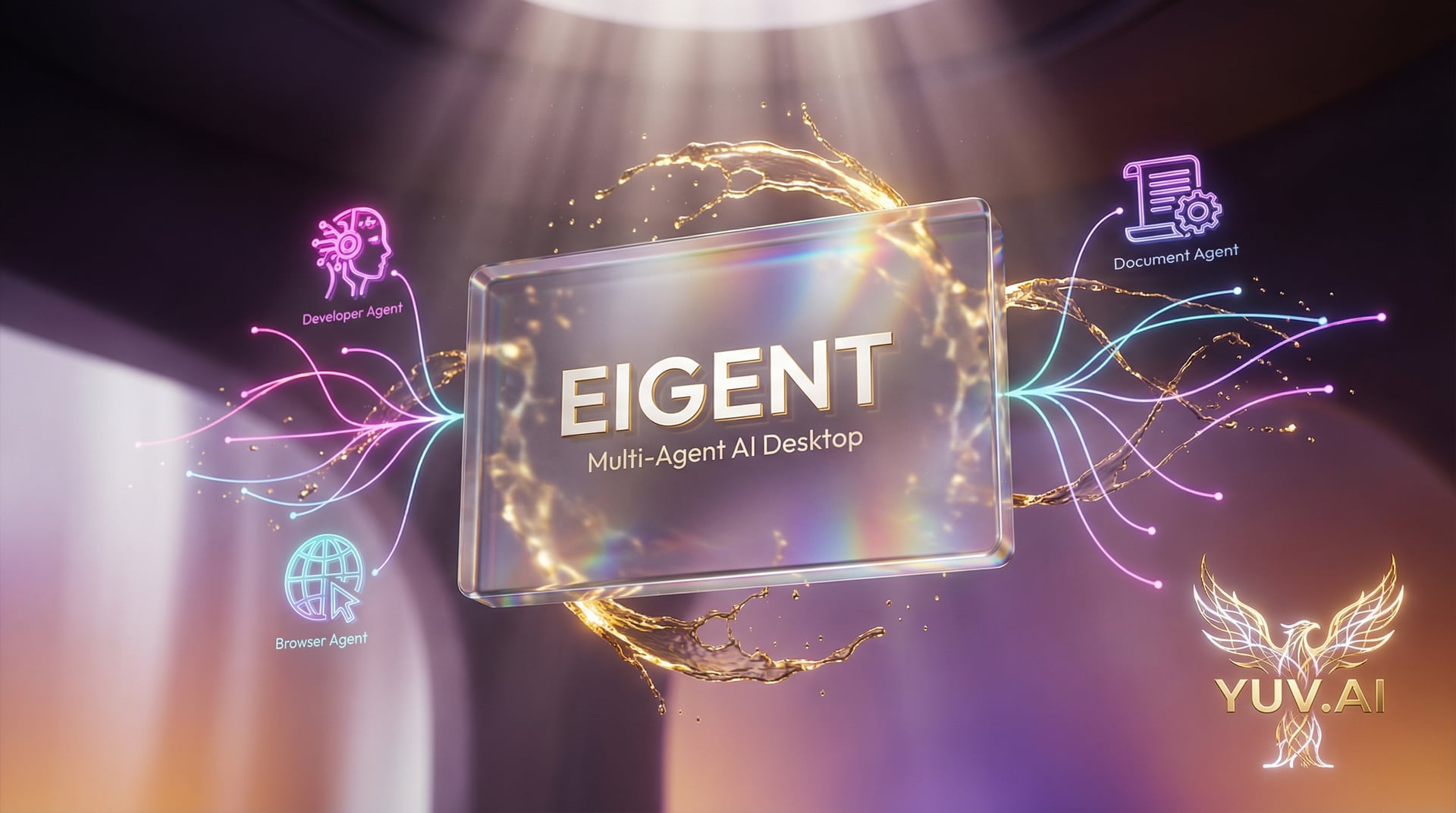
Eigent is an open-source desktop application that orchestrates specialized AI agents locally to automate complex, multi-step workflows while maintaining complete data privacy. Created by eigent-ai, it brings enterprise-grade multi-agent capabilities to our local machines without requiring cloud infrastructure.
What is Eigent?
Eigent is a desktop platform that deploys what the team calls a "personal AI workforce" on our local machine. The project Eigent solves the problem of running sophisticated multi-agent AI systems that we all face when working with sensitive data or in environments where cloud connectivity isn't an option.
Built on the CAMEL-AI framework, Eigent orchestrates multiple specialized agents—Developer, Browser, Document, and Multi-Modal agents—that collaborate to tackle complex tasks. The key differentiator: everything runs locally, meaning our proprietary code, sensitive documents, and confidential data never leave our machine.
The Problem We All Know
We've been dealing with a fundamental tension in AI agent development. On one side, we have powerful cloud-based solutions that offer sophisticated capabilities but require sending our data to external servers. On the other side, we have basic local tools that preserve privacy but lack the coordination needed for complex workflows.
For those of us working in regulated industries, handling proprietary code, or simply valuing data sovereignty, this creates an impossible choice. We either compromise on privacy or settle for limited functionality. Neither option is acceptable when we're trying to build serious AI-powered automation.
Existing multi-agent frameworks typically assume cloud deployment. They're designed for scenarios where compute resources are abundant and network connectivity is guaranteed. But what about air-gapped environments? What about working with trade secrets? What about developers who simply don't want their code analyzed by external services?
How Eigent Works
Eigent takes a fundamentally different approach by combining several key technologies into a cohesive local platform.
At its core sits the CAMEL-AI framework, which handles multi-agent orchestration—meaning it coordinates how different specialized agents communicate and delegate tasks to each other. Think of it like a project manager who knows which team member has which expertise and assigns work accordingly.
For the actual language models, Eigent supports local execution through vLLM and Ollama. vLLM is a high-performance inference engine that optimizes how LLMs run on our hardware, while Ollama provides an easy way to download and run models locally. This means we can use powerful models like Llama 2, Mistral, or Code Llama without any external API calls.
The architecture uses a FastAPI/Python backend for the orchestration logic and a React/Electron frontend for the desktop interface. This gives us a familiar, responsive UI while keeping all the heavy computation local.
What makes this particularly powerful is the integration of Model Context Protocol (MCP). MCP extends what agents can do by providing standardized interfaces to external tools and data sources. Our agents can interact with databases, call APIs, manipulate files—all while staying on our machine.
Quick Start
Here's how we get started with Eigent:
# Clone the repository
git clone https://github.com/eigent-ai/eigent.git
cd eigent

# Install dependencies
pip install -r requirements.txt

# Configure local LLM (example with Ollama)
ollama pull mistral

# Launch Eigent
python main.py
A Real Example
Let's say we want to analyze our codebase for potential security vulnerabilities and generate a report:
from eigent import AgentOrchestrator, DeveloperAgent, DocumentAgent

# Initialize the orchestrator
orchestrator = AgentOrchestrator(
    llm_backend="ollama",
    model="mistral"
)

# Configure specialized agents
dev_agent = DeveloperAgent(
    name="SecurityAnalyzer",
    capabilities=["code_review", "vulnerability_scan"]
)

doc_agent = DocumentAgent(
    name="ReportGenerator",
    capabilities=["markdown_generation", "pdf_export"]
)

# Execute the workflow
task = "Scan the ./src directory for security issues and create a detailed report"
result = orchestrator.execute(
    task=task,
    agents=[dev_agent, doc_agent],
    output_format="pdf"
)

print(f"Report generated: {result.output_path}")
Key Features
- Privacy-First Architecture - All processing happens on our local machine. No data leaves our environment unless we explicitly configure external integrations. Think of it like having a completely offline team that works in a secure room.
- Specialized Agent Roles - Developer agents handle code-related tasks, Browser agents interact with web content, Document agents process and generate documents, Multi-Modal agents work with images and other media. Each agent is optimized for its domain, similar to how we'd structure a real team with specialists.
- Human-in-the-Loop Control - We can configure checkpoints where agents must get our approval before proceeding. This is crucial for high-stakes operations where we want oversight without micromanaging every step.
- Local LLM Support - Compatible with vLLM and Ollama, meaning we can run models ranging from compact 7B parameter models to larger 70B+ models depending on our hardware. We control the trade-off between performance and resource usage.
- MCP Integration - Agents can access external tools and services through standardized interfaces. This extensibility means we're not locked into a fixed set of capabilities—we can add custom tools as our needs evolve.
- Enterprise Features - Role-based access control allows team deployments where different users have different permissions. Audit logging tracks what agents do for compliance purposes.
When to Use Eigent vs. Alternatives
Eigent excels in scenarios where data privacy is non-negotiable. If we're working with proprietary code, handling regulated data (healthcare, finance), or operating in air-gapped environments, Eigent provides capabilities that cloud-based solutions simply can't offer.
For straightforward automation where cloud connectivity isn't an issue, services like AutoGPT or AgentGPT offer simpler setup and don't require managing local infrastructure. They're great for general-purpose tasks where data privacy isn't a primary concern.
LangChain and CrewAI are excellent frameworks for building custom agent systems, but they require more development work. Eigent provides a ready-to-use desktop application with pre-configured agents, making it more accessible for teams that want multi-agent capabilities without building from scratch.
For enterprise orchestration at scale, platforms like Microsoft Semantic Kernel or Google's Agent Builder offer more mature ecosystems and professional support. However, they assume cloud deployment and come with corresponding costs and data considerations.
My Take - Will I Use This?
In my view, Eigent addresses a real gap in the agent ecosystem that's been bothering me for months. We finally have a path to sophisticated multi-agent orchestration without the privacy compromises of cloud services.
I'm particularly excited about using this for client work where code confidentiality is contractually required. The ability to run comprehensive code analysis, documentation generation, and workflow automation locally solves a significant pain point. No more explaining to clients why their proprietary algorithms need to touch external APIs.
The MCP integration is forward-thinking. As we build custom tools and integrations, having a standardized protocol means our agents can leverage them without major refactoring. This extensibility matters for long-term adoption.
That said, the hardware requirements are real. Running multiple agents with decent-sized LLMs locally demands serious compute resources. Teams will need to budget for appropriate workstations or servers. The setup complexity is also higher than clicking "sign up" on a cloud service—there's a learning curve here.
Bottom line: for privacy-sensitive workflows and regulated environments, this is exactly what we've needed. For quick experiments or non-sensitive work, simpler cloud options might still make sense.
Check out the project: Eigent on GitHub
Frequently Asked Questions
What is Eigent?
Eigent is an open-source desktop application that orchestrates specialized AI agents locally to automate complex workflows while maintaining complete data privacy.
Who created Eigent?
Eigent was created by eigent-ai. The project is open-source and actively maintained on GitHub.
When should we use Eigent?
Use Eigent when working with sensitive data, proprietary code, or in regulated environments where cloud-based AI solutions aren't viable due to privacy or compliance requirements.
What are the alternatives to Eigent?
Cloud alternatives include AutoGPT and AgentGPT for simpler use cases. Framework alternatives include LangChain and CrewAI for custom development. Enterprise platforms like Microsoft Semantic Kernel offer more mature ecosystems but assume cloud deployment.
What are the limitations of Eigent?
Eigent requires significant local compute resources to run multiple agents with LLMs effectively. Setup is more complex than cloud services, and teams need technical expertise to deploy and maintain the system.
Does Eigent support cloud LLMs?
While Eigent is designed for local execution with vLLM and Ollama, it can be configured to use cloud API endpoints if needed. However, this defeats the privacy-first architecture that makes Eigent unique.
Can Eigent work in air-gapped environments?
Yes, once set up with local models, Eigent can operate completely offline in air-gapped environments, making it suitable for highly secure or isolated networks.