
Yuval Avidani
Author
Key Takeaway
ChatDev 2.0 'DevAll' is a zero-code multi-agent orchestration platform that breaks free from rigid virtual company structures to support flexible agent workflows across any domain. Created by OpenBMB, it transforms how we design multi-agent systems by offering both visual drag-and-drop interfaces and programmatic Python SDK control.
What is ChatDev 2.0?
ChatDev 2.0 'DevAll' is a comprehensive multi-agent orchestration platform that evolved from its predecessor's fixed virtual software company model into a flexible system supporting any complex task workflow. The project ChatDev solves the problem of inflexible agent collaboration patterns that we all face when trying to build multi-agent systems beyond simple code generation scenarios.
Where ChatDev 1.0 locked us into predefined roles (CEO, CTO, Programmer, Designer), version 2.0 introduces a decoupled architecture with visual workflow design, making multi-agent orchestration accessible to both developers and non-technical users.
The Problem We All Know
We've all hit this wall: existing multi-agent frameworks force us into rigid patterns. ChatDev 1.0 was brilliant for software generation—it gave us a virtual company that could build applications from natural language descriptions. But what happens when we need agents for data visualization? 3D content generation? Research automation? The fixed company structure became a constraint rather than a feature.
Most orchestration tools today make us choose between two extremes: either we get a no-code solution with limited flexibility, or we dive into complex code-based frameworks that require deep technical knowledge. We spend hours wiring together agent interactions, debugging communication protocols, and managing state across distributed agent systems.
Existing tools like LangGraph offer powerful capabilities but come with steep learning curves. Other platforms provide simplicity but lock us into their specific patterns. We needed something that bridges this gap—accessible enough for rapid prototyping, powerful enough for production systems.
How ChatDev 2.0 Works
ChatDev 2.0 introduces a three-layer architecture that separates concerns cleanly: Server (state management), Runtime (agent execution), and Workflow (logic definition). Think of it like modern web architecture—your database layer, application server, and business logic are independent but work together seamlessly.
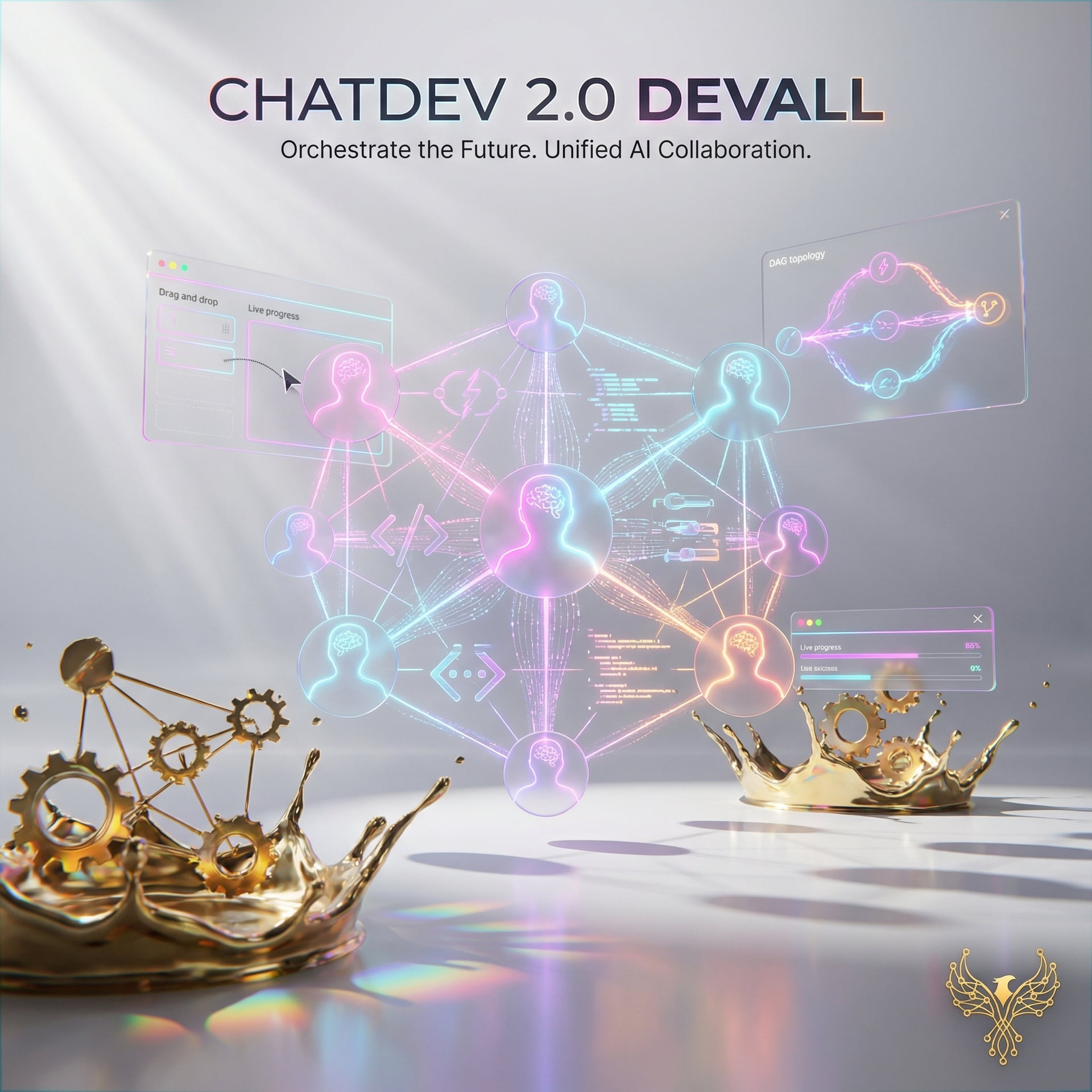
The visual console, built with Vue3, provides a drag-and-drop canvas where we design agent networks. Each agent is a node, interactions are edges, and we configure collaboration patterns visually. For developers who want programmatic control, the Python SDK exposes the full orchestration engine.
What makes this different: ChatDev 2.0 integrates research-backed collaboration patterns from OpenBMB's NeurIPS 2025 papers. MacNet (Multi-Agent Collaboration Networks) handles complex agent topologies—meaning we can create networks where agents communicate in sophisticated patterns, not just linear chains. Puppeteer brings dynamic orchestration—agents can evolve their interaction strategies based on task requirements.
Quick Start
Here's how we get started with ChatDev 2.0:
# Clone the repository
git clone https://github.com/OpenBMB/ChatDev.git
cd ChatDev

# Install dependencies
pip install -r requirements.txt

# Launch the visual console (Vue3 interface)
npm install
npm run dev

# Or use the Python SDK directly
from chatdev import Orchestrator, Agent

orchestrator = Orchestrator()
agent1 = Agent(role="analyst", capabilities=["data_processing"])
agent2 = Agent(role="visualizer", capabilities=["chart_generation"])

orchestrator.add_agents([agent1, agent2])
result = orchestrator.run(task="analyze sales data")
A Real Example
Let's say we want to build a research automation workflow. We need agents to search papers, summarize findings, and synthesize insights:
# Define our research workflow
from chatdev import Workflow, Agent, DAGTopology

# Create specialized agents
searcher = Agent(
    name="paper_searcher",
    role="research",
    tools=["arxiv_search", "semantic_scholar"]
)

summarizer = Agent(
    name="paper_summarizer",
    role="analysis",
    tools=["text_extraction", "summarization"]
)

synthesizer = Agent(
    name="insight_synthesizer",
    role="synthesis",
    tools=["cross_reference", "knowledge_graph"]
)

# Define workflow topology (DAG-based)
topology = DAGTopology()
topology.add_edge(searcher, summarizer)  # searcher outputs to summarizer
topology.add_edge(summarizer, synthesizer)  # summarizer outputs to synthesizer

# Create and execute workflow
workflow = Workflow(agents=[searcher, summarizer, synthesizer], topology=topology)
results = workflow.execute(
    query="recent advances in multi-agent reinforcement learning",
    max_papers=10
)

print(results.synthesis)
Key Features
- Decoupled Architecture - Server, Runtime, and Workflow layers operate independently, making the system modular and scalable. Think of it like microservices for agent orchestration—we can scale each component separately based on our needs.
- Visual Workflow Designer - Vue3-based console with drag-and-drop interface eliminates coding for basic scenarios. It's like using a flowchart tool, but each box is an intelligent agent and each arrow is a communication channel.
- Python SDK for Power Users - Programmatic access to the full orchestration engine allows us to define complex workflows, custom agent behaviors, and dynamic routing logic that adapts during execution.
- Research-Backed Patterns - Integration of MacNet and Puppeteer from NeurIPS 2025 papers brings academic rigor to practical implementation. We're not guessing about agent collaboration—we're using proven patterns from peer-reviewed research.
- DAG-Based Topologies - Directed Acyclic Graph support means we can model complex dependencies and parallel execution paths. Agent A can feed results to both Agent B and Agent C simultaneously, while Agent D waits for both to complete.
- Dynamic Agent Routing - Agents can change their interaction patterns based on runtime conditions. If one approach fails, the system can try alternative collaboration strategies without manual intervention.
When to Use ChatDev 2.0 vs. Alternatives
ChatDev 2.0 excels when we need flexible multi-agent orchestration beyond code generation. If our use case involves data analysis pipelines, content creation workflows, research automation, or any scenario where multiple specialized agents must collaborate, this platform provides the right balance of accessibility and power.
Compare this to LangGraph, which offers incredibly powerful capabilities but requires deep understanding of its graph-based programming model. LangGraph is perfect for developers who want fine-grained control and don't mind the learning curve. ChatDev 2.0 prioritizes faster onboarding through visual tools while still offering SDK access for advanced users.
For simple single-agent applications or straightforward prompt chains, tools like LangChain might be simpler. ChatDev 2.0's strength emerges when agent interactions become complex—multiple agents with different roles, conditional routing, parallel execution, and evolving collaboration patterns.
If we're building production systems that need visual monitoring and runtime modification of agent workflows, ChatDev 2.0's console provides capabilities that code-only frameworks lack. We can literally watch our agent network execute and adjust behaviors on the fly.
My Take - Will I Use This?
In my view, ChatDev 2.0 represents a significant step toward democratizing multi-agent development. The visual interface lowers barriers for product managers, researchers, and domain experts who understand workflows but don't want to write orchestration code. At the same time, the Python SDK keeps experienced developers happy by providing full programmatic control.
I'm particularly excited about the integration of academic research. Too often, papers about multi-agent systems stay in academia while practitioners reinvent the wheel. OpenBMB bridges this gap by implementing MacNet and Puppeteer patterns directly in production-ready code.
The use cases where this shines for our workflow: research automation (my team spends hours manually reviewing papers), data analysis pipelines (where different agents handle ingestion, transformation, and visualization), and content generation workflows (where agents collaborate on research, writing, and editing).
Limitations to watch: As a 2.0 rewrite, some features are still maturing. Documentation may lag behind capabilities as the platform evolves. The visual console is impressive but might not cover every edge case—complex conditional logic might still require SDK usage. Performance characteristics at scale need real-world validation.
Bottom line: ChatDev 2.0 is going into our experimentation stack immediately. For prototyping multi-agent workflows, it's now our first choice. For production deployments, we'll validate performance and stability before committing fully.
Explore the project: ChatDev on GitHub
Frequently Asked Questions
What is ChatDev 2.0?
ChatDev 2.0 'DevAll' is a zero-code multi-agent orchestration platform created by OpenBMB that enables flexible agent workflow design for any domain using visual tools or Python SDK, moving beyond the rigid virtual software company model of version 1.0.
Who created ChatDev 2.0?
ChatDev 2.0 was created by OpenBMB, a research organization that integrates cutting-edge multi-agent collaboration research (including their NeurIPS 2025 papers on MacNet and Puppeteer) into practical tools.
When should we use ChatDev 2.0?
Use ChatDev 2.0 when we need flexible multi-agent systems for complex workflows beyond simple code generation—data analysis, content creation, research automation, or any scenario requiring sophisticated agent collaboration with conditional routing and parallel execution.
What are the alternatives to ChatDev 2.0?
Alternatives include LangGraph (more powerful but steeper learning curve, best for developers wanting fine-grained control), LangChain (simpler for basic prompt chains and single-agent apps), and AutoGen (Microsoft's framework with strong typing and structured conversations). ChatDev 2.0 differentiates with visual design tools and research-backed collaboration patterns.
What are the limitations of ChatDev 2.0?
As a 2.0 rewrite, some features are still maturing and documentation may lag behind capabilities. The visual console might not cover every edge case for complex conditional logic, requiring fallback to SDK usage. Performance at scale needs real-world validation as the platform evolves.