
Yuval Avidani
Author
What Happens When You Let AI Versions of Warren Buffett and Cathie Wood Fight Over the Same Stock?
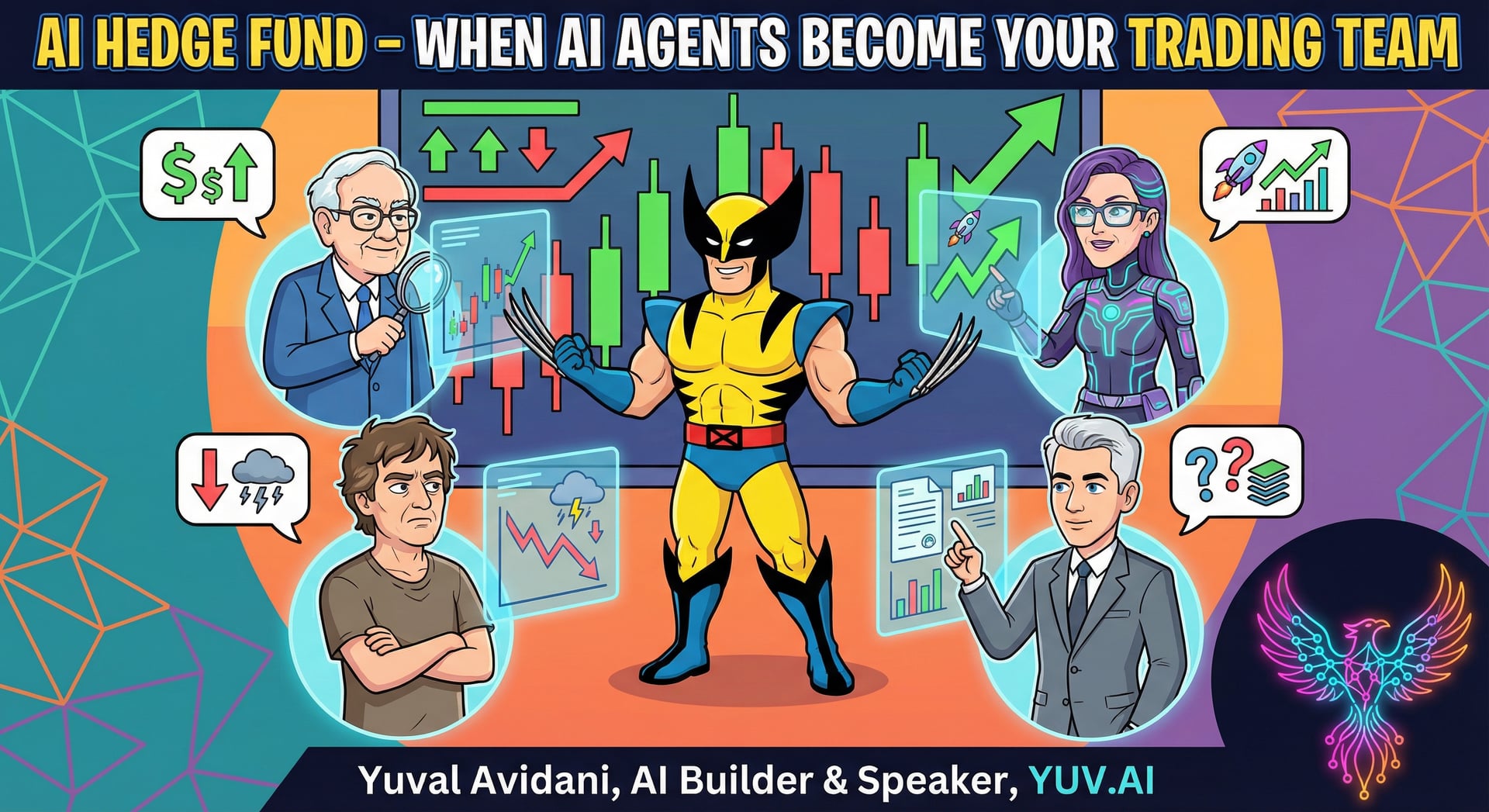
The project AI Hedge Fund solves the problem of single-strategy bias in trading by simulating an entire hedge fund team using multiple AI agents with completely different investing philosophies.
This matters because most of us - whether we're building trading bots, analyzing stocks, or just trying to make smarter investment decisions - fall into the trap of confirmation bias. We find one strategy that makes sense, we optimize for it, and we ignore signals that contradict our worldview. This repo shows a different way: let multiple AI agents with conflicting strategies debate the same data and force them to reach a consensus.
The Problem We All Know Too Well
Decision paralysis in trading is brutal. You're staring at a stock, reading analyst reports that contradict each other, watching the price bounce around, and your own bias is screaming at you to either buy or run away. By the time you make a decision, the moment has passed.
Traditional algorithmic trading doesn't solve this - it just automates one person's bias. A value-investing algorithm will never pivot to growth strategies when the market shifts, because it's not designed to question its own assumptions. Robo-advisors smooth out some of the emotional volatility, but they're still rigid systems optimizing for predetermined rules.
What we've been missing is a system that can hold multiple conflicting viewpoints simultaneously, debate them in real-time, and synthesize a decision that considers all angles. That's not easy to build - it requires orchestrating multiple AI models, giving each one a distinct personality and strategy, and creating a mechanism for them to challenge each other without descending into chaos.
How This Multi-Agent Trading System Actually Works
The AI Hedge Fund repo simulates a hedge fund using what's called a multi-agent system - meaning multiple AI agents (separate instances of language models with different instructions and personas) working together on the same problem.
Here's the architecture: First, two specialist agents gather data. A Valuation Agent crunches financial metrics - revenue growth, profit margins, debt ratios, all the numbers that fundamental analysts care about. A Sentiment Agent reads news articles, earnings call transcripts, and market commentary to gauge whether sentiment around the stock is positive or negative.
Then come the investor persona agents. Each one is an LLM (Large Language Model - an AI trained to understand and generate human-like text) prompted to think like a specific legendary investor:
- Warren Buffett Agent: Obsessed with intrinsic value, long-term moats, and buying undervalued companies with strong fundamentals.
- Cathie Wood Agent: Hunting for disruptive innovation, exponential growth potential, and companies that could dominate the next decade.
- Bill Ackman Agent: Looking for activist opportunities - companies where strategic changes or management shakeups could unlock value.
- Michael Burry Agent: Playing contrarian deep-value bets, skeptical of hype, searching for mispriced assets everyone else is ignoring.
All four agents receive the same data from the Valuation and Sentiment agents, but they reach completely different conclusions based on their investing philosophy. The Buffett agent might say "solid fundamentals, but overpriced - pass." The Cathie Wood agent might say "revenue growth is explosive, this is the future - buy aggressively." The Burry agent might say "everyone's too bullish, this is a bubble - short it."
Finally, a Portfolio Manager agent acts as the tie-breaker. It reads all four conflicting recommendations, weighs them based on confidence levels and market conditions, and makes the final trading decision. Think of it like a board of directors voting on a strategy - except the entire process runs automatically in code.
The system uses OpenAI's API for the LLM reasoning (you can swap in other providers), pulls real financial data from market APIs, and orchestrates the entire debate using Python. The codebase is modular, so you can add new investor personas, tweak the decision-making logic, or integrate different data sources without rewriting everything.
Real-World Use Cases for Multi-Agent Trading Systems
Scenario 1: Analyzing a Growth Stock During Earnings
You're evaluating a high-flying tech company that just reported earnings. The Valuation Agent flags that revenue beat expectations but profit margins are shrinking. The Sentiment Agent sees that mainstream media is ecstatic but institutional investors are quietly selling. The Buffett agent says the valuation is insane. The Cathie Wood agent says this is a buying opportunity because the innovation pipeline is stacked. The Ackman agent suggests the company needs new leadership. The Burry agent thinks everyone's missing the debt problem. The Portfolio Manager synthesizes all this and decides: small position now, revisit in 30 days after the hype dies down.
Scenario 2: Testing Investment Strategies Without Risk
You're building a trading bot and you want to test how different strategies perform under the same market conditions. Instead of running one backtest at a time, you deploy the multi-agent system and let all four personas trade simultaneously on historical data. You see that the Buffett agent outperformed during bear markets, the Cathie Wood agent crushed it during bull runs, and the Burry agent saved you from three major crashes. Now you know how to weight your own strategy.
Why This Is Different from Robo-Advisors and Algo Trading
Traditional algorithmic trading platforms like QuantConnect or MetaTrader optimize for one strategy. You define the rules - moving averages, RSI thresholds, support and resistance levels - and the algorithm executes them mechanically. They're fast and emotionless, but they're also brittle. When market conditions shift, they keep executing the same logic until you manually intervene.
Robo-advisors like Betterment or Wealthfront smooth out emotional volatility by automating portfolio rebalancing and tax-loss harvesting. But they're still optimizing for a predetermined risk profile. They don't debate whether your risk profile should change based on market conditions.
This multi-agent approach is different because it simulates debate and consensus-building. Instead of one rigid strategy, you get multiple conflicting strategies fighting it out in real-time. The Portfolio Manager agent doesn't just pick the loudest voice - it weighs confidence levels, considers market context, and synthesizes a decision that no single agent would have reached alone.
You'd choose this over traditional algo trading when you want to explore multiple strategies simultaneously without running separate backtests. You'd choose robo-advisors when you want set-it-and-forget-it automation. You'd choose this multi-agent system when you want to see how different investing philosophies would react to the same data and make decisions that consider multiple viewpoints.
My Take - Should You Actually Use This for Real Trading?
In my opinion, this is one of the most interesting applications of multi-agent AI I've seen this year - but not for the reasons you might think. Is it ready to manage real money? Absolutely not. These AI agents are only as smart as the prompts and data you give them. A real Warren Buffett doesn't mechanically follow value-investing rules - he adapts based on decades of pattern recognition and judgment calls that no LLM can replicate yet.
But as a framework for exploring how AI agents can collaborate on complex decisions? This repo nails it. The codebase is clean, the architecture is modular, and the approach demonstrates something bigger than trading - it shows how you can build systems where multiple AI personas challenge each other to reach better decisions than any single model could achieve alone.
The use cases where this shines: backtesting multiple strategies simultaneously, teaching yourself how different investing philosophies react to the same data, prototyping decision-making systems that need to consider diverse viewpoints. The limitation is that LLMs hallucinate, they're sensitive to prompt wording, and they don't have the decades of market intuition that real legendary investors possess.
If you're building multi-agent systems, exploring agentic AI architectures, or just curious how AI agents can debate and reach consensus on complex problems, this repo is worth digging into. Check it out at https://github.com/virattt/ai-hedge-fund and see how the architecture handles agent orchestration, conflict resolution, and decision synthesis. Even if you never deploy it for real trading, the patterns here apply to any domain where you need multiple expert perspectives working together.